
While vintage Corelle dishware used to be a dime a dozen at every estate sale and thrift shop, it’s finally making a comeback in the vintage-loving community. Read on to learn about the most collectible and valuable vintage Corelle dishware, some of which your granny likely has stashed in her kitchen cabinets.
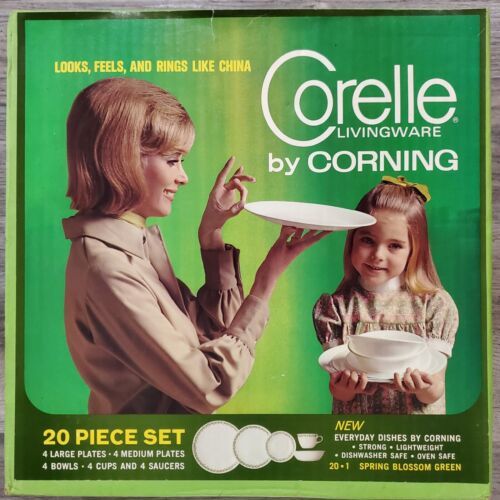
Corelle was first released in 1970 by Corning Glass Works.
Back in Style
Sure, everyone is familiar with the high value of some iconic 1930s-1970s American glass and ceramic brands such as Pyrex and Fiesta, but did you know that old Corelle dishes are creeping back in style? This comeback may be to the chagrin of collectors of the goods mentioned above, as Corelle is known for being a “cheaper” brand originally marketed to budget-minded housewives.
Despite their lowly reputation, Corelle dishes have a place in American manufacturing history and are rising in value in today’s vintage marketplace.
Corning Glass Works: Pyrex, Corningware, & Corelle
Corelle was first manufactured by Corning Glass Works, a name familiar to any vintage glassware collector worth their salt. Corning Glass was initially known as the Bay State Glass Co. when it was founded in 1851 in Somerville, Massachusetts, and then changed its name to the Brooklyn Flint Glass Works upon relocation to Williamsburg, Brooklyn. Needing more space, the company finally put down roots in Corning, NY, in 1868, where it could expand its glass production of industrial goods, such as car headlamps and windshields, and its nascent lines of consumer cookware.
Starting in the early 20th century, Corning began producing kitchenware under the brands Pyrex, Corningware, and Corelle. Corning first launched Pyrex in 1915, after developing a special recipe for glass that could withstand high temperatures and therefore be used in the oven. Collectors today still fawn over vintage Pyrex, partly due to its long production period over the course of the 20th century, which resulted in a tremendous spectrum of colors,patterns, shapes, and sizes.
As for Corningware, in 1952, a Corning chemist accidentally discovered a new “glass ceramic” material that was good with high temperatures and freezing temperatures. Dubbed “Corningware,” this new material had the added benefit of rarely breaking, making it perfect for going from the freezer to the oven to the table. You’re likely familiar with Corningware’s classic blue cornflower pattern if you ate a home-cooked meal anywhere from 1960 to 1990.
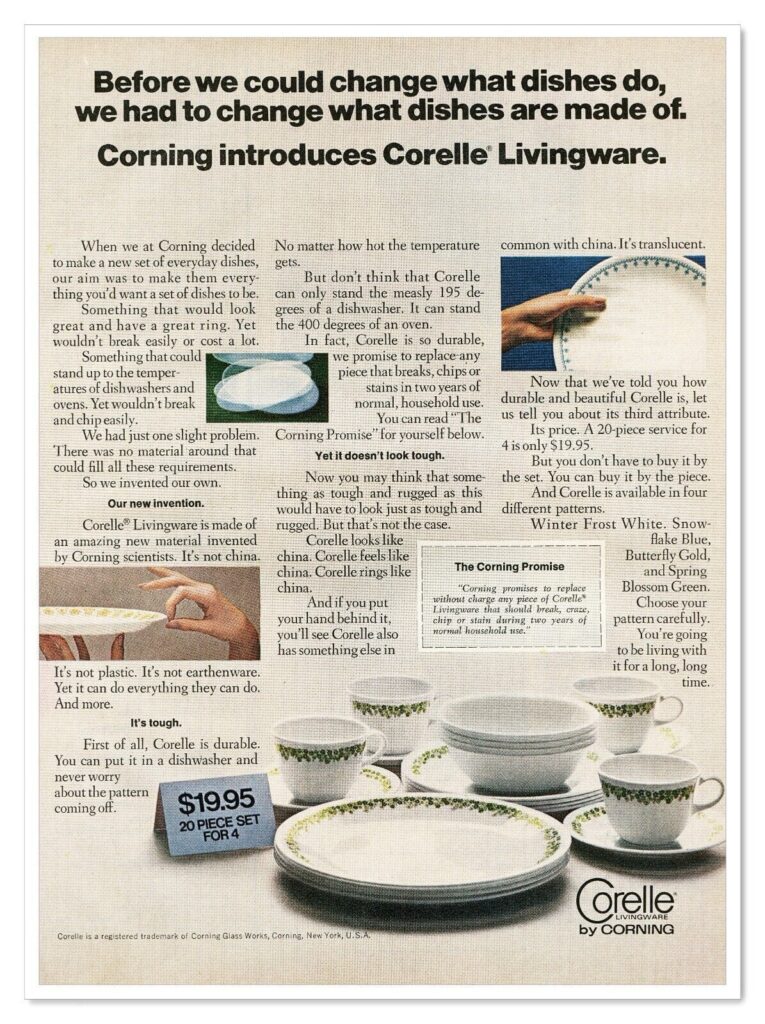
qualities of the innovative dishware.
From Spring Blossom Green to Butterfly Gold
Interestingly, both Pyrex and Corningware were first developed just as new glass materials without a specific purpose in mind, while, in the mid-1960s, Corning scientists specifically went about creating a new laminated, very thin glass to be used for serving ware: Corelle. Corelle was marketed as “Corelle Livingware – New – Everyday Dishes by Corning – Strong – Lightweight – Dishwasher Safe – Oven Safe.” This new dishware was made of three bonded glass layers and came in four attractive patterns: Snowflake Blue, Old Towne Blue, Butterfly Gold, and Spring Blossom Green. All these hues fit snugly in 1970s kitchens already outfitted with avocado green and harvest gold appliances.
Lucky for vintage advertising lovers, Corning not only had a team of scientists developing the Corelle product but also a marketing team dedicated to packaging and selling this new product to American housewives. A full 20-piece set was only $19.95, and print ads showed women “pinging” a Corelle plate, saying that it “looks, feels, and rings like china.”
Corelle was instrumental in changing middle-class American dining habits in the 1970s, reducing the need for formal china and offering a chic yet inexpensive way to serve family meals. While ownership of the Corning and Corelle brands has changed over the years, amazingly, Corelle is still being made today and is available both online and at big box (and discount) stores.
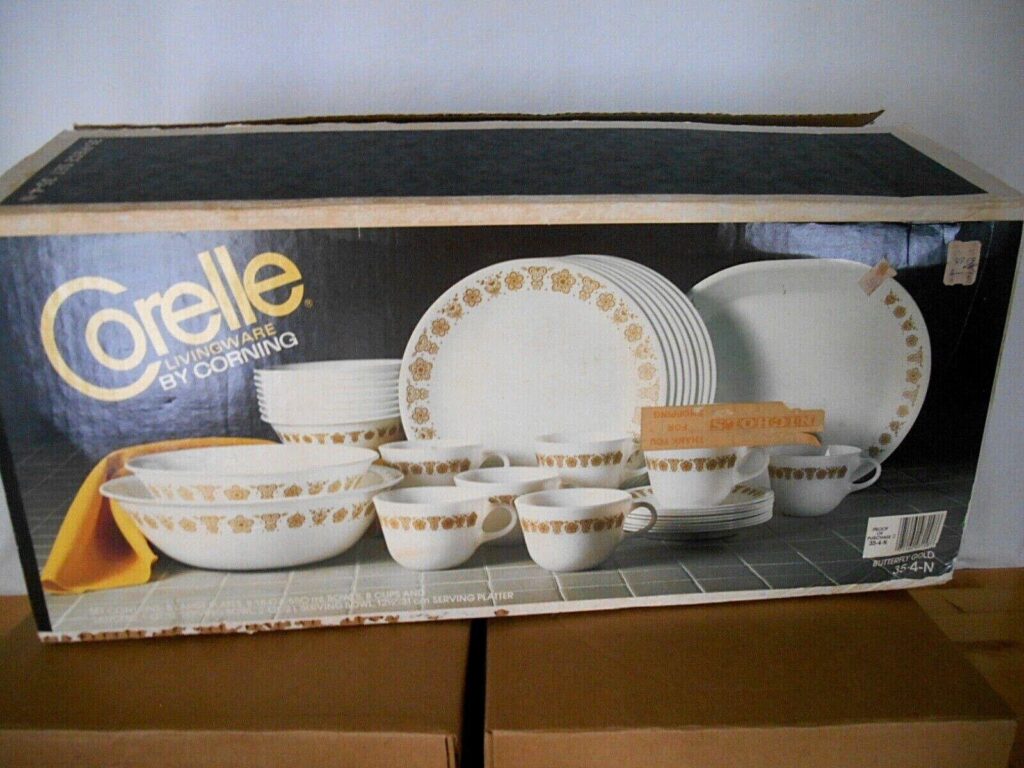
along with Old Towne Blue, Spring Blossom Green, and Snowflake Blue.
Tips for Collectors
As a reseller, I have seen a resurgence of vintage Corelle’s popularity at vintage and antique marketplaces. While I am hopeful that some of these dishes are simply going to collectors as display pieces, it is important to be aware that some of the early printed decorations on Corelle dishes have tested positive for lead.
It’s pretty impossible to know which ones have lead and which don’t, but an excellent rule of thumb is to avoid eating off vintage Corelle dishes with noticeable wear, fading, or chipping in the painted decoration. All Corelle manufactured after 2005 complies with updated lead regulations from that year, so those dishes are undoubtedly the safest for today’s everyday use.
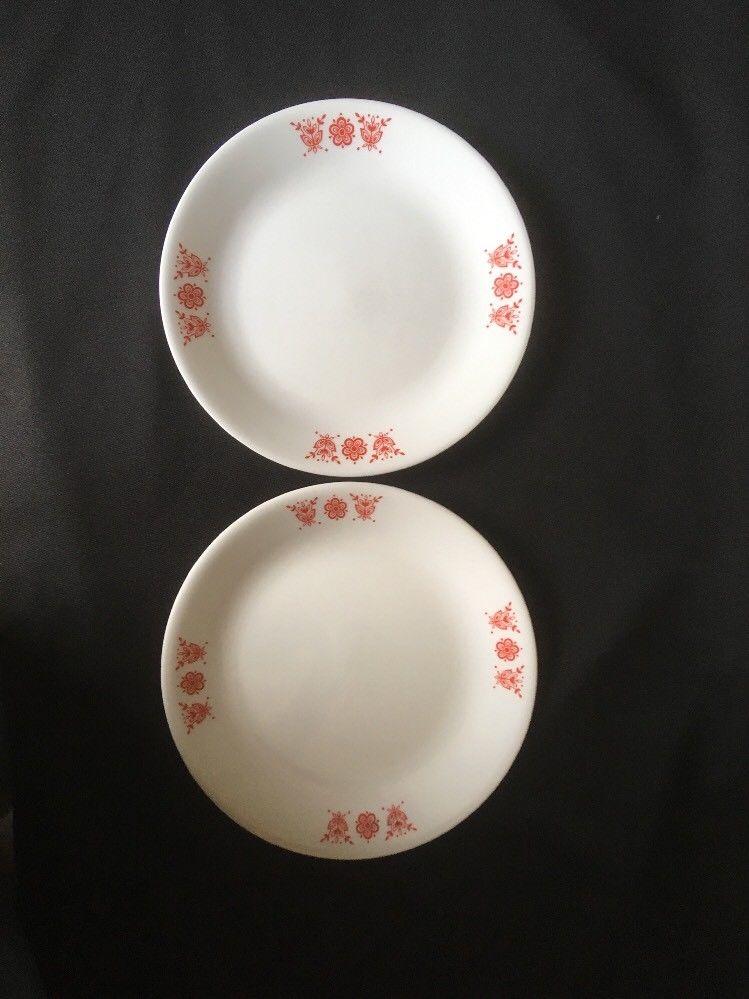
pink test pattern sold for $700 online.
Corelle’s Most Collectible Patterns
That said, collectors still love vintage patterns. The four original patterns—Spring Blossom Green, Snowflake Blue, Old Towne Blue, and Butterfly Gold—are all still coveted by Corelle lovers. These patterns in rare or “factory test” colors fetch some of the highest prices today on the secondary marketplace.
Since Corelle is still manufactured today, some Corelle patterns are valuable simply because they appeal to collectors of tangential collectibles. For instance, Peanuts fans adore Corelle Peanuts dishes, such as the black-and-white Peanuts/ Snoopy Travel pattern, which routinely sells for over $300 online.
Collectors also enjoy holiday-themed sets and seasonal employee giveaway plates, which appear occasionally online—this set of Corelle Employee Giveaway plates sold for nearly $300 in 2024.
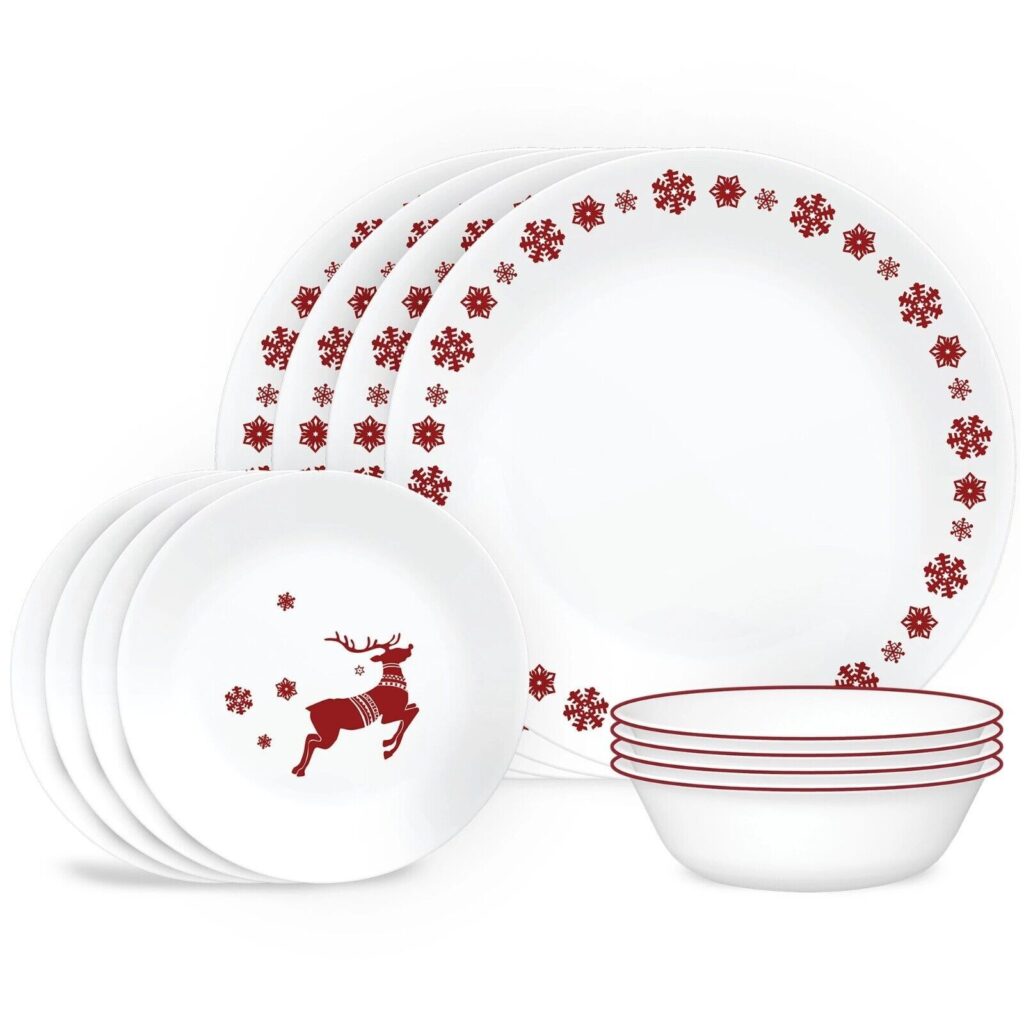
If you collect vintage Corelle, I would also suggest checking out Corelle’s current website to see if anything catches your eye from contemporary releases. Many patterns, such as Northern Pines, Anders, and Terracotta Dreams, have such retro appeal in their own right that you may get ahead of the collecting game by stashing away some of today’s timeless Corelle designs!
Courtesy of Amy Moyer, the proprietor of Antmuffin: Art, Antiques & Collectibles.
She holds a B.A. in Visual Arts from Brown University and lives in Boston.